
A go-live date sets the timeline. Evidence determines whether the business is ready.
On July 27, 2026, Something Somewhere Consulting facilitated a full-day, end-to-end go-live readiness validation with the Cabalen Group as part of its Odoo 19 implementation journey.
The session was designed to answer a critical question that every ERP project must eventually face: Can the organization confidently operate its core business processes in the new system?
Rather than treating readiness as a checklist or assuming that completed configuration meant the organization was prepared to launch, the activity focused on proving how work moved across teams, processes, and system records.
Key users and process owners worked through critical transactions, reviewed handoffs, confirmed actual system outcomes, documented supporting evidence, identified gaps, and retested items requiring further attention. The objective was to create a clear and defensible view of readiness based on what the system and its users could demonstrate—not simply on schedule pressure.
Readiness Is More Than a Working System
An ERP platform can be technically configured and still leave a business unprepared for go-live.
True readiness requires more than confirming that users can create transactions. It means validating that business processes remain complete and traceable as work moves from one department to another.
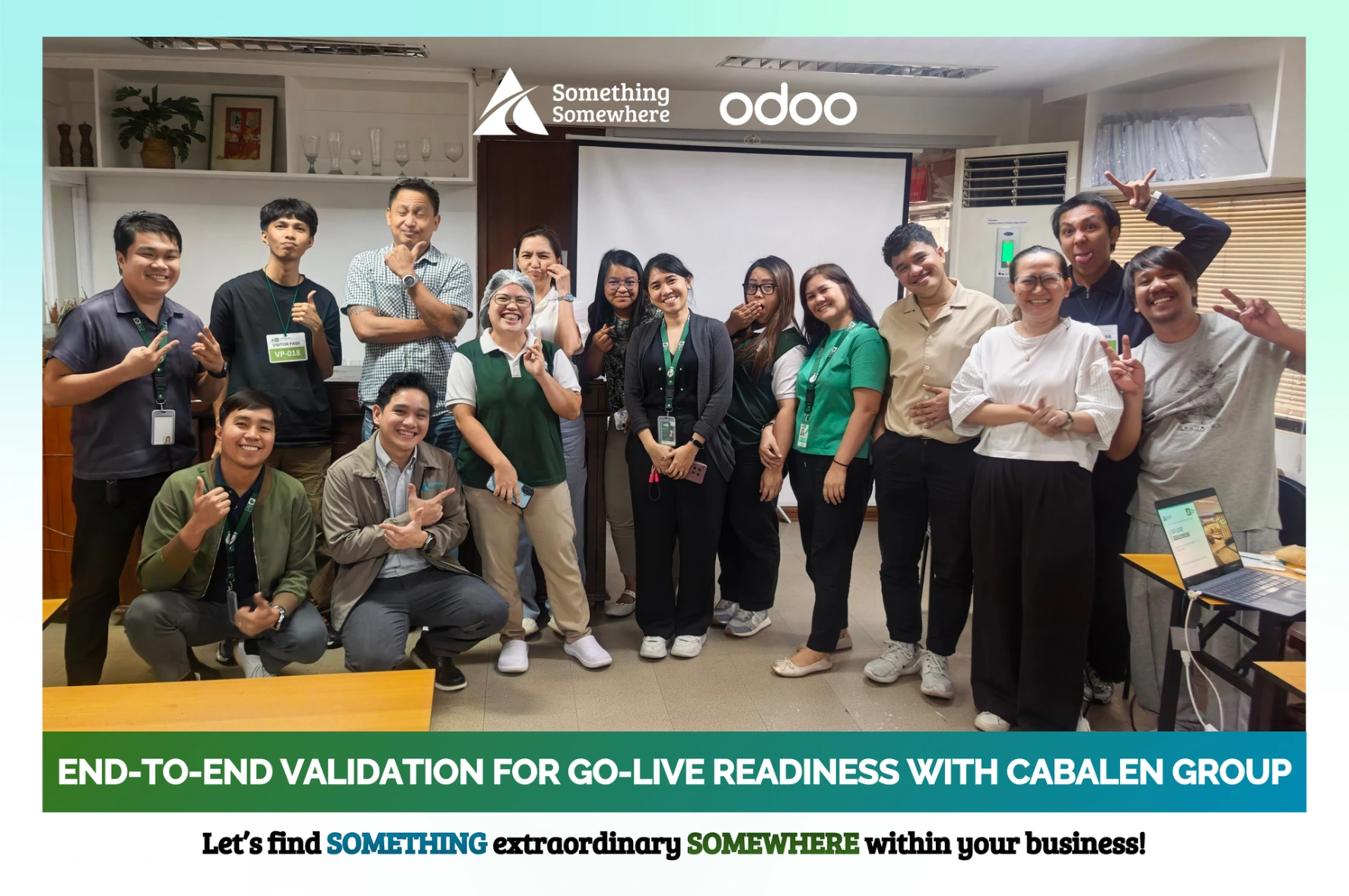
For the Cabalen Group, the one-day validation examined both process readiness and launch readiness. This included user access, assigned roles, process handoffs, transaction execution, accounting closure, cutover evidence, and clear ownership of remaining actions.
This approach reflects a broader principle behind successful digital transformation: technology should support a better way of working, not simply replace one set of tools with another.
At Something Somewhere Consulting, we believe transformation becomes meaningful when people understand their responsibilities, processes operate consistently, and systems provide the visibility and control needed to make informed decisions. That positioning is central to Something Somewhere Consulting’s role as a practical transformation partner—not only a software implementer.
Testing the Business as One Connected Flow
One of the most important parts of the session was validating the business as a connected operating chain.
Instead of testing departments in isolation, the team examined how information, quantities, values, ownership, and accountability moved across the organization.
The day covered several core process areas.
Order-to-Cash
The order-to-cash validation followed the journey from customer demand through order creation, stock reservation, delivery, invoicing, payment, and bank reconciliation.
The team reviewed whether:
- Sales orders contained the correct customer, items, quantities, and pricing
- Deliveries were properly reserved, completed, and reflected in inventory
- Invoices posted with the correct values, taxes, journals, and balances
- Customer payments were recorded and reconciled against the correct bank entries
The process was not considered complete simply because an invoice existed. The full flow had to end with a properly posted and reconciled transaction in Odoo.
Manufacture-to-Fulfill
The manufacture-to-fulfill scenario tested how the organization would respond when available finished goods were not enough to meet demand.
This included reviewing raw material availability, manufacturing order creation, material consumption, yield, quality checks, rework, finished-goods storage, delivery, and costing.
The validation helped confirm whether production activity could be traced from the original requirement through to the final delivered and costed output.
It also reinforced an important control: only output that passed the required quality checks should proceed, while failed output should follow a clearly documented rework process.
Procure-to-Pay
The procure-to-pay validation examined how demand became a completed and settled supplier transaction.
The flow covered supplier selection, purchase order preparation, approvals, supplier confirmation, receipt, quantity and quality differences, vendor billing, payment, bank reconciliation, and stock valuation.
By validating the full chain, the team could determine whether differences were visible and approved before they affected inventory or payment, and whether procurement, finance, and stock records remained aligned.
Strengthening Financial Control Before Go-Live
Financial readiness was another major focus of the session.
The team reviewed several accounting areas that are essential for a controlled launch, including:
- Full payment and accounts receivable reconciliation
- Bank statement imports
- Customer credits
- Aged accounts receivable and accounts payable
- Trial balance, profit and loss, and balance sheet alignment
- Tax reporting and lock-date controls
These checks help ensure that transactions are not only operationally complete but also financially reliable.
Where a workaround may still be necessary, it should not remain informal. The exposure, owner, deadline, and compensating control must be documented and accepted. This helps prevent temporary workarounds from becoming permanent sources of risk.
Building an Evidence Chain
A central principle of the readiness exercise was that a result should count only when another reviewer can reconstruct it.
For every validated process, the team considered whether the original source, the Odoo transaction, the responsible user, the posted outcome, and the proof reference were clearly connected.
This evidence chain helps answer a practical management question:
Can another person trace the transaction from its source to its final result without relying on memory?
That level of traceability is essential for accountability, control, troubleshooting, and future audits.
It also helps move the organization away from processes that depend heavily on individual knowledge and toward a more consistent operating model supported by reliable system records.
Readiness Decisions Should Follow Evidence
The readiness session was not intended to force a positive result.
Its purpose was to show what worked, expose what still required attention, and establish clear conditions for the next decision.
The readiness framework allowed for several possible recommendations:
- Go, when critical flows passed and no critical or high-priority defects remained open
- Conditional Go, when remaining risks were bounded, controlled, assigned to an owner, and given a clear deadline
- No-Go, when a critical process, control, access requirement, or cutover item had not been proven
This evidence-based approach protects the business from moving forward simply because a target date has already been announced.
A responsible go-live recommendation must balance momentum with operational control.
A Shared Commitment to Better Ways of Working
The July 27 session represented more than a technical testing activity.
It brought together business users, process owners, and implementation specialists around one shared objective: making sure the organization was prepared to operate confidently in a new environment.
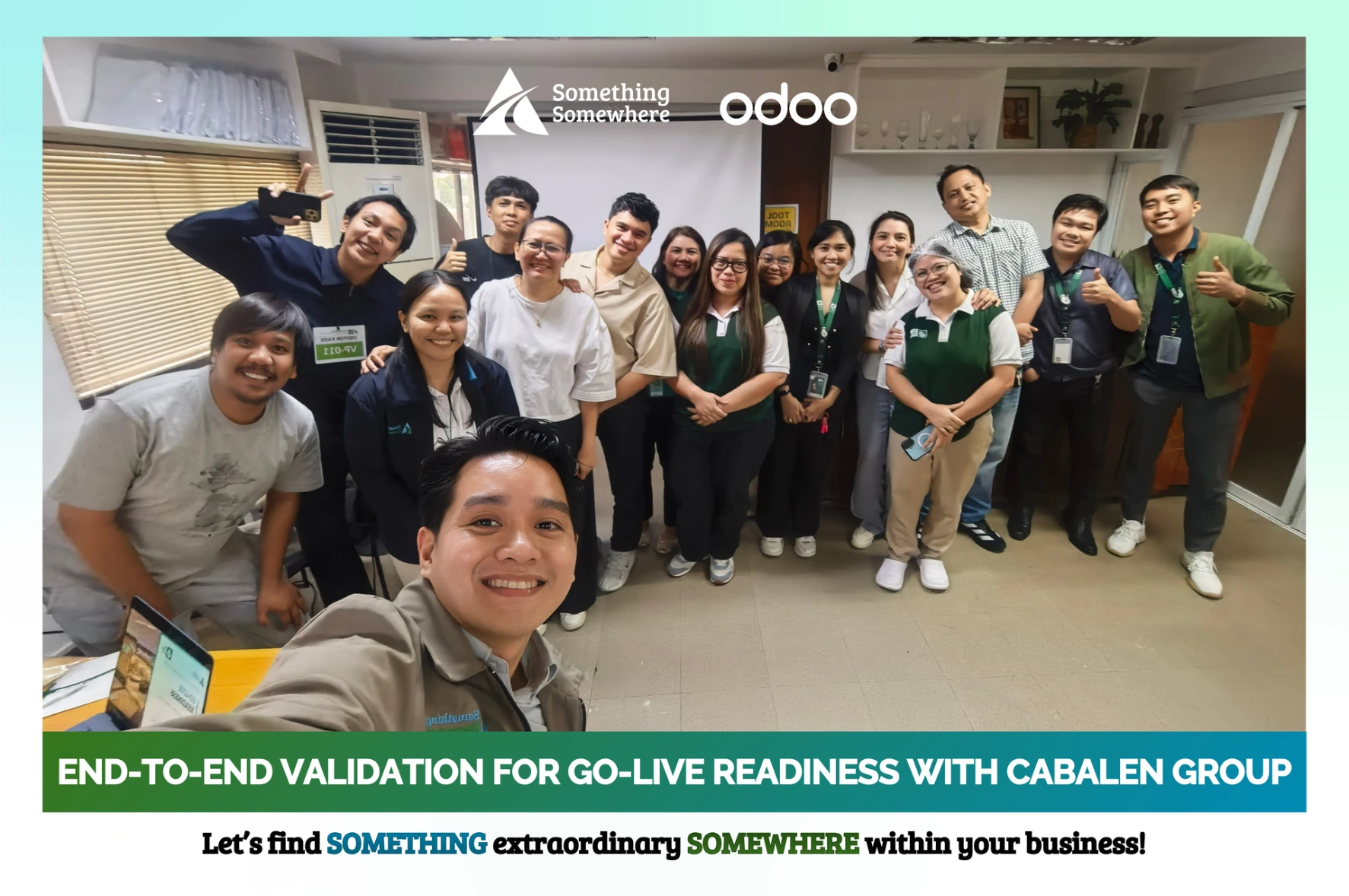
For the Cabalen Group, the exercise helped make process gaps visible, clarify ownership, strengthen coordination, and establish the evidence needed for the next stage of the implementation.
For Something Somewhere Consulting, it reflected the way we approach ERP implementation and digital transformation.
We do not believe the end goal is simply to launch a system.
The goal is to help businesses standardize how work is done, align teams around shared processes, enable those processes through the right digital tools, and build the confidence needed to sustain change after go-live.
The most valuable outcome of an ERP journey is not the software alone. It is a stronger operating model—one that gives the organization better visibility, better control, better continuity, and a better way of working.
Moving Toward Go-Live With Clarity
As the Cabalen Group continues its go-live preparation, the focus remains on closing outstanding items, confirming cutover requirements, validating access and data, and ensuring that critical transactions can be completed and traced in Odoo 19.
Every successful implementation requires moments like this: moments when teams pause, test the full process, challenge assumptions, and make decisions based on evidence.
That is how readiness becomes more than a claim.
It becomes something the business can prove.
📩 Let’s Continue the Conversation
Ready to explore what better processes, greater visibility, and an integrated ERP system could unlock for your organization?
Start Somewhere with Something Somewhere Consulting and begin building a practical path toward sustainable business transformation.