
Digital transformation should not begin with software.
It should begin with understanding the business.
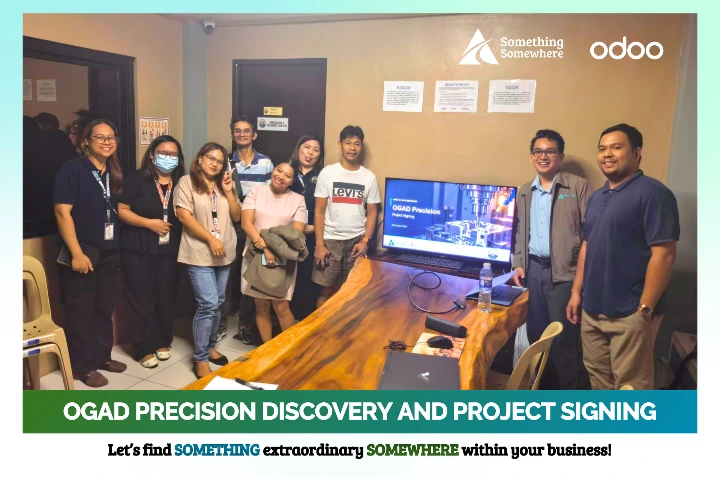
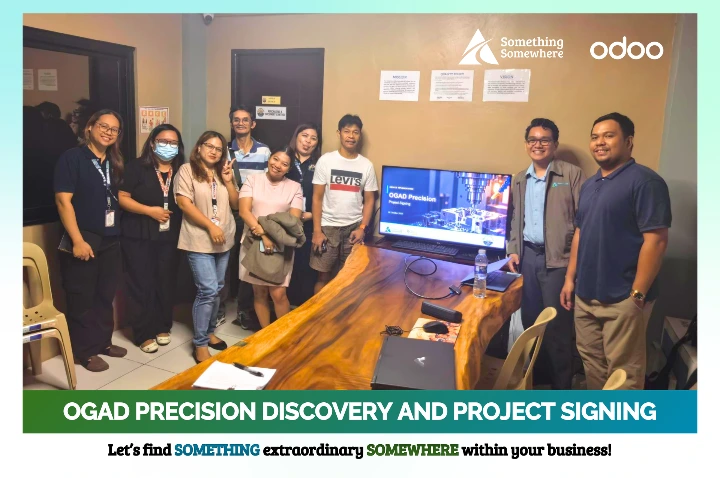
On October 28, 2026, Something Somewhere Consulting joined OGAD Precision and Industrial Toolings Corp. for a Precision Discovery and Project Signing, marking the beginning of a new Odoo 20 ERP transformation journey.
The milestone represents more than the start of a technology project.
It begins a collaborative process of understanding how work happens today, identifying opportunities to create stronger and more consistent processes, and establishing how technology can support a better way of working.
For Something Somewhere Consulting, that is where meaningful ERP transformation starts.
Discover first. Standardize what matters. Enable it with the right system. Help people make the change part of everyday operations.
Why ERP Implementation Should Start With Discovery
Businesses considering ERP often begin with a simple question:
What can the system do?
It is an important question – but it should not be the first one.
A better starting point is:
How does the business work today, and how should it work tomorrow?
Before configuring an ERP platform organizations need to understand their existing processes, responsibilities, handoffs, controls, information requirements, and the areas where work becomes unnecessarily difficult.
That is the purpose of Precision Discovery.
Rather than immediately translating every current practice into software, discovery creates an opportunity to examine the way work gets done and determine what should be retained, improved, standardized, or reconsidered.
Technology can make a good process faster.
But it can also make an unclear process more complicated.
That is why SSC follows a practical principle.
Standardize before you digitize.
Beginning OGAD Precision's Odoo 20 Journey
The Project Signing with OGAD Precision marks the beginning of a structured Odoo 20 ERP implementation journey with Something Somewhere Consulting.
The project begins with discovery and alignment—creating a shared understanding of the business before implementation progresses further.
This matters because one of the most common challenges in ERP projects is configuring technology before everyone agrees on the process the technology is supposed to support.
By starting with business understanding, both teams can establish a stronger foundation for the transformation ahead.
The objective is not simply to make a new system operational.
It is to make sure the system supports a better way of operating.
Precision Discovery Goes Beyond Requirements Gathering
Traditional ERP discovery can sometimes become a checklist.
What fields are needed?
What reports are required?
What should the system automate?
What does the current software already do?
Those questions have value, but they do not always reveal the real business problem.
Precision Discovery goes deeper.
It creates space to ask questions such as:
How does work actually move between people and teams?
Where are responsibilities unclear?
Which activities still depend heavily on manual work?
Where does management need greater visibility?
Which processes should become more consistent?
What already works well and should be preserved?
Which requirements can be handled through standard Odoo?
Where will people need support as their way of working changes?
These conversations help distinguish between a genuine business requirement and a preference for recreating an old way of working.
That distinction is important.
A new ERP should not simply reproduce yesterday’s processes in a newer interface.
It should help the organization build a stronger operating model.
Odoo 20 as an Enabler, Not the Starting Point
Odoo 20 provides the technology platform for the transformation.
But at SSC, technology is not where the conversation begins.
The starting point is the business.
Processes first. Systems next. Adoption throughout.
A successful Odoo implementation should help organizations improve areas such as:
process consistency;
operational visibility;
accountability;
information flow;
control;
collaboration; and
continuity.
The platform enables these improvements.
But the organization must first understand what a better way of working should look like.
Why Process Standardization Matters
As organizations grow, processes naturally evolve.
Different teams may develop different ways of completing similar work.
Employees may create spreadsheets or manual workarounds to fill gaps.
Approvals may happen through separate communication channels.
Critical knowledge can become dependent on individual employees.
And processes that once worked for a smaller organization may become harder to manage as the business expands.
ERP implementation creates an opportunity to address this.
Before introducing automation, organizations can establish a practical common denominator for how work should be performed.
That is process standardization.
It does not mean forcing every situation into exactly the same workflow.
It means creating enough consistency that people understand:
what should happen;
who is responsible;
what information is required;
what comes next;
what controls matter; and
where the organization can see the status of the process.
Once that foundation exists, digital systems become significantly more valuable.
Standard Odoo First
Another important principle in sustainable ERP implementation is resisting unnecessary customization.
A business should not customize a new platform simply because its previous system worked differently.
SSC takes a standard-first approach.
That means beginning with proven Odoo capabilities and evaluating whether the organization can adopt a practical standard process before introducing additional complexity.
This approach can help reduce long-term challenges around:
upgrades;
testing;
maintenance;
training;
support; and
system ownership.
Customization may still be appropriate where there is a justified business need.
But it should solve a real requirement—not simply preserve an old habit.
The better question is:
Can we improve the process before we customize the system?
ERP Implementation Is a Business Transformation Project
ERP projects involve technology.
But their success depends heavily on people.
Leaders make decisions.
Process owners clarify how work should happen.
Users validate whether workflows are practical.
Teams prepare information.
Employees learn new responsibilities.
And ultimately, people decide whether the new way of working becomes part of everyday operations.
That is why ERP implementation should not be treated as an IT project alone.
It is a business transformation initiative enabled by technology.
For OGAD Precision, Precision Discovery and Project Signing represent the beginning of that shared journey.
The work ahead is not simply about making Odoo operational.
It is about making sure the business and the system move in the same direction.
Discovery Creates the Foundation for Better Decisions
One of the most valuable outcomes of discovery is clarity.
Before organizations invest time in configuration, automation, or customization, they should be able to answer fundamental questions about the future way of working.
What should remain?
What should change?
What should become standardized?
What can Odoo handle through standard functionality?
Where does the organization need stronger ownership?
What does successful adoption look like?
Answering these questions early gives both the business and implementation team a stronger basis for future decisions.
It also creates shared ownership.
Instead of technology being imposed on the organization, the future way of working becomes something the organization helps define.
User Adoption Begins Before Go-Live
ERP adoption should not begin when a system is already ready to launch.
It starts much earlier.
People need to understand:
why change is happening;
what the organization is trying to improve;
how processes may evolve;
what their responsibilities will be; and
how the new system will support their work.
When that context exists, training becomes more meaningful.
Users are not simply memorizing which buttons to press.
They understand the process behind the system.
For SSC, this reflects an important belief:
Transformation is people-led, not tool-led.
Technology can enable change.
People make it sustainable.
Better Ways of Working Before More Technology
ERP discussions can easily become dominated by features.
But features are not business outcomes.
Businesses do not invest in ERP because they want more menus, screens, or buttons.
They invest because they want to operate better.
They want:
Better visibility.
Better control.
Better continuity.
Better accountability.
Better ways of working.
Technology becomes valuable when it helps create those outcomes.
That is why SSC approaches Odoo implementation as more than software deployment.
We help organizations understand what already works, identify where untapped potential exists, standardize where consistency matters, and enable those improvements through the right systems and adoption support.
A New Transformation Journey Begins
The Precision Discovery and Project Signing with OGAD Precision marks the beginning of that journey.
It starts with conversations.
Questions.
Understanding.
Alignment.
And a shared commitment to creating something better.
As the project progresses, that understanding will provide the foundation for the decisions that follow.
But the principles remain simple:
Understand before configuring.
Standardize before digitizing.
Validate before adopting.
Enable people, not just systems.
That is how ERP implementation moves beyond technology and becomes sustainable business transformation.
We thank the OGAD Precision and Industrial Toolings Corp. team for the trust and collaboration as we begin this journey together.
Because sometimes transformation does not start by adding something new.
Sometimes it starts by discovering the extraordinary potential already somewhere within the business.
📩 Let’s Continue the Conversation
Ready to explore what better processes, greater visibility, and an integrated ERP system could unlock for your organization?
Start Somewhere with Something Somewhere Consulting and begin building a practical path toward sustainable business transformation.